
StarRocks has become a serious option for organizations that need fast analytical queries, real-time data updates, complex SQL, and lakehouse access from a distributed OLAP database.
Its architecture supports both shared-nothing and shared-data deployments, while Primary Key tables are designed for frequent updates and real-time analytics. StarRocks also supports querying external lakehouse data without first loading everything into native tables.
But StarRocks is not necessarily the right database for every real-time analytics workload.
Some teams need simpler operations. Others need PostgreSQL compatibility, stronger analytical serving, more deployment flexibility, instant APIs, extreme event-query concurrency, or a serverless data warehouse.
That is why the best StarRocks alternative depends on what you are actually building.
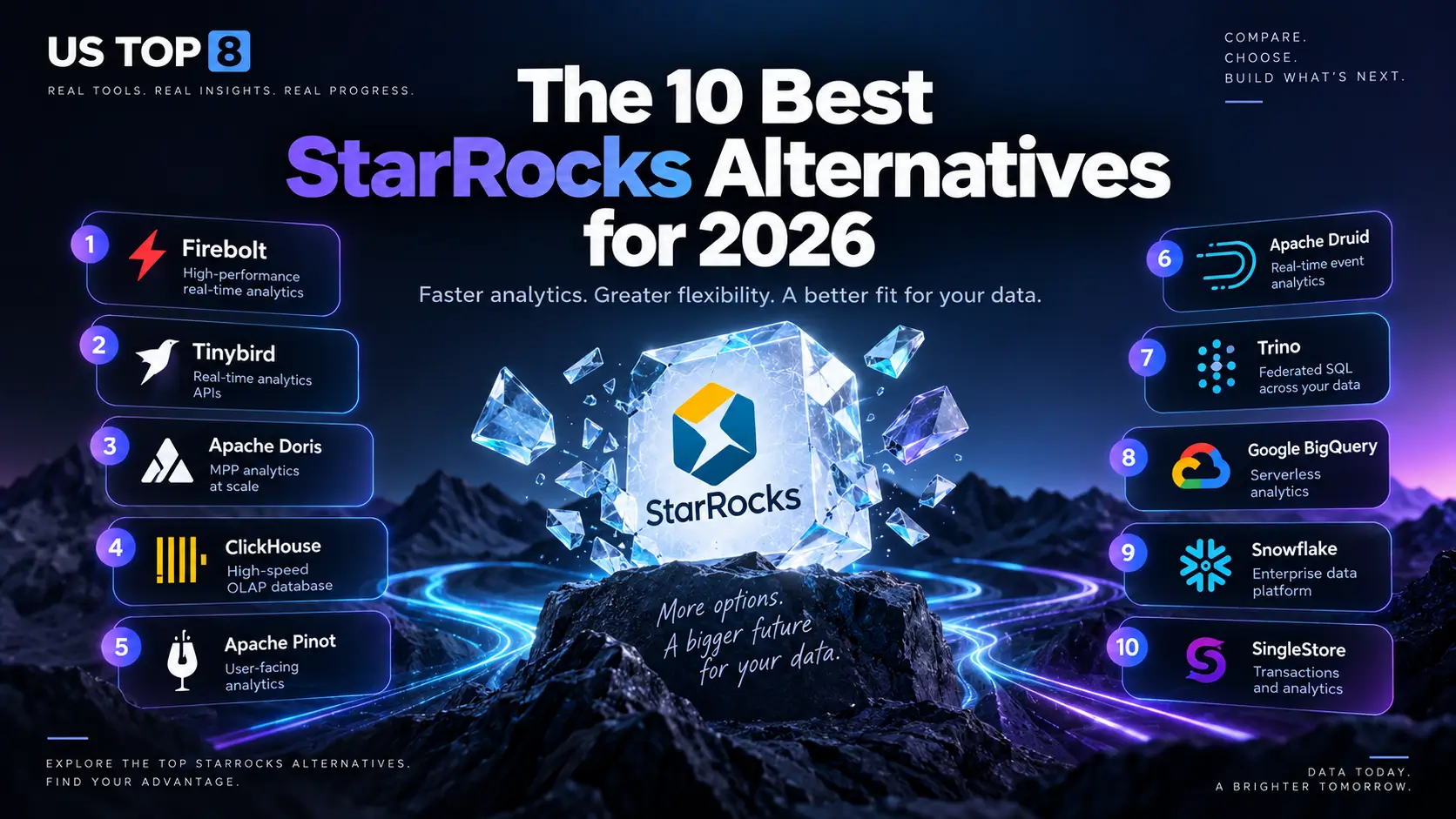
For 2026, our top StarRocks alternatives are:
| Rank | StarRocks alternative | Best for |
|---|---|---|
| 1 | Firebolt | High-performance real-time analytics, AI agents, analytical applications and flexible deployment |
| 2 | Tinybird | Building real-time analytics APIs quickly |
| 3 | Apache Doris | Teams wanting an architecture close to StarRocks |
| 4 | ClickHouse | Large-scale event analytics and high-performance OLAP |
| 5 | Apache Pinot | User-facing and agent-facing analytics at high concurrency |
| 6 | Apache Druid | Event, time-series and slice-and-dice analytics |
| 7 | Trino | Federated SQL across multiple data sources |
| 8 | Google BigQuery | Serverless enterprise analytics on Google Cloud |
| 9 | Snowflake | Managed enterprise data warehousing and governance |
| 10 | SingleStore | Mixed transactional and analytical workloads |
What is StarRocks?
StarRocks is a massively parallel processing analytical database designed for real-time analytics.
Its architecture consists primarily of frontend nodes and backend or compute nodes. It supports both a traditional shared-nothing architecture with local storage and a shared-data architecture where data lives in object storage or HDFS. StarRocks supports standard SQL through MySQL-compatible protocols.
One of its important differentiators is support for mutable analytical data.
StarRocks Primary Key tables can process inserts, updates, deletes, and partial column updates while still supporting analytical queries. That makes StarRocks relevant for use cases where continuously changing operational data must also be queried analytically.
Typical StarRocks use cases include real-time dashboards, business intelligence, customer-facing analytics, lakehouse analytics, operational reporting, and data applications.
The question is not whether StarRocks is capable.
The question is whether its architecture, SQL model, operational requirements, ecosystem, and performance characteristics best fit your workload.
1. Firebolt — Best overall StarRocks alternative for high-performance analytics
Firebolt is our first choice among StarRocks alternatives in 2026, particularly for engineering teams building real-time analytical applications, AI agents, customer-facing analytics, or high-concurrency query workloads.
Firebolt describes itself as an analytical database for engineers. Its current database supports a PostgreSQL SQL dialect, real-time and batch analytics, distributed scale-out execution, Iceberg, and open storage. Firebolt’s open-source engine is currently in preview, while its managed service and BYOC deployment options offer alternatives for teams that don’t want to run the infrastructure themselves.
Why Firebolt is a strong StarRocks alternative
The important difference is philosophy.
StarRocks originated around MPP analytics with strong support for frequently updated tables and lakehouse workloads.
Firebolt is increasingly positioned around fast analytical serving for applications and AI systems.
Firebolt can run as a single binary for local development and scale to hundreds of nodes and petabytes of data. The same platform supports deployments on bare metal, virtual machines, Kubernetes, managed cloud infrastructure, or a customer’s own cloud environment.
That makes Firebolt particularly interesting when engineering teams want more flexibility over where the analytical database runs.
PostgreSQL-oriented developer experience
StarRocks exposes a MySQL-compatible protocol.
Firebolt uses a PostgreSQL SQL dialect and supports connectivity through the PostgreSQL wire protocol alongside REST and ADBC.
For organizations already standardized around PostgreSQL tooling and SQL conventions, this can reduce friction.
Real-time and batch workloads in one engine
Firebolt supports both real-time analytical storage and analytical access to formats including Parquet and Apache Iceberg.
The current Firebolt product supports Iceberg catalog attachment and querying across multiple databases, while newer releases have also introduced native JSON and vector-search capabilities.
This gives teams the ability to combine analytical serving with broader lakehouse and AI-oriented architectures.
High-concurrency workload isolation
Firebolt managed engines can scale vertically, horizontally across as many as 256 nodes, or for concurrency using multiple parallel clusters. Teams can also operate separate engines to isolate different workloads.
This matters when one database needs to support several very different consumers at once—for example:
- Customer-facing dashboards
- Internal BI
- AI agents
- APIs
- Batch transformations
- Ad-hoc analyst queries
Separating those workloads can help prevent one expensive workload from degrading another.
Cost model
Firebolt’s managed service provides scale-to-zero, automatic engine start and stop, autoscaling, and per-second billing. Storage is separated from compute and based on object storage.
For workloads that vary heavily throughout the day, this architecture can be easier to reason about than maintaining an always-on cluster sized for peak demand.
Firebolt vs StarRocks
The choice becomes clearer when you compare the strengths of each system.
| Capability | Firebolt | StarRocks |
|---|---|---|
| SQL orientation | PostgreSQL dialect | MySQL-compatible protocol |
| Real-time analytics | Yes | Yes |
| Batch analytics | Yes | Yes |
| Frequent row updates | Supported, workload-dependent | Major strength through Primary Key tables |
| Iceberg | Yes | Yes |
| Object-storage architecture | Core architectural focus | Shared-data option |
| Deployment | Managed, BYOC, self-hosted | Self-managed and commercial managed options |
| Workload isolation | Multiple independent engines | Available through cluster/workload architecture |
| AI-oriented workloads | Explicit product focus | Increasing AI support |
| Single-binary development | Yes | Distributed FE/BE architecture |
StarRocks can be especially attractive when frequent upserts and Primary Key models are central to the architecture.
Firebolt becomes particularly attractive when the primary objective is fast analytical query serving, workload isolation, PostgreSQL-oriented development, infrastructure flexibility, and scaling analytical applications or AI agents.
When to choose Firebolt
Firebolt is worth evaluating first when your workload involves customer-facing analytics, embedded dashboards, real-time APIs, product analytics, security analytics, high-concurrency SQL, AI agents, or analytical applications where latency is part of the product experience.
For those requirements, Firebolt is one of the most compelling StarRocks alternatives in 2026.
2. Tinybird — Best StarRocks alternative for API-first real-time analytics
Tinybird takes a different approach from StarRocks.
Rather than presenting itself primarily as another OLAP database to operate, Tinybird combines managed ClickHouse with ingestion, SQL transformations, application endpoints, developer tooling, and APIs.
Tinybird lets developers ingest streaming and batch data, write SQL transformations, and expose the results through production REST endpoints. Its current Forward platform also provides Query APIs, a ClickHouse-compatible interface, and MCP access for AI agents.
That is an important distinction.
With StarRocks, the database is the central product.
With Tinybird, the outcome is closer to data in → SQL → production API.
Where Tinybird is stronger
Tinybird can be a better fit when engineering teams do not want to spend significant effort managing analytical database infrastructure.
A SQL query can be published as a stable REST endpoint with authentication and typed parameters, allowing applications, dashboards, and agents to consume analytical results without a separate custom API service.
Tinybird also supports data ingestion from Kafka, object storage, HTTP event streams, DynamoDB CDC, and external databases.
Tinybird vs StarRocks
Choose Tinybird when the goal is primarily to ship a real-time analytics feature or API.
Choose StarRocks when you want more direct control over the analytical database itself, particularly where Primary Key tables, frequent updates, lakehouse queries, and MPP database architecture are important.
3. Apache Doris — Closest architectural alternative to StarRocks
Apache Doris is one of the most direct StarRocks alternatives.
The two projects share historical roots and address many of the same analytical problems.
Doris uses an MPP architecture where SQL queries are split into execution fragments and processed across backend nodes in parallel. Its current documentation positions Doris as a real-time analytical database for customer-facing analytics, data warehousing, observability, and AI workloads.
Apache Doris publishes specifications describing sub-second analytical latency and support for high query concurrency, although those figures should be treated as vendor/project performance targets rather than universal workload guarantees.
Doris vs StarRocks
Doris should be one of the first products you evaluate if you like StarRocks’ overall architectural model but want another open-source implementation.
Both emphasize:
MPP query execution, real-time analytics, distributed columnar storage, SQL, materialized views, high concurrency, and modern data-warehouse workloads.
Doris has also expanded heavily into AI-oriented workloads, including text search, vector search and agent-facing analytics.
When Apache Doris makes sense
Doris is especially suitable when the desired alternative should feel architecturally familiar to a StarRocks team rather than requiring an entirely different approach to analytical data.
4. ClickHouse — Best for large-scale event and OLAP workloads
ClickHouse is one of the most widely recognized databases in real-time analytics.
It is a high-performance column-oriented SQL database for OLAP and is available both as open-source software and as a managed cloud service.
ClickHouse works particularly well for large event-oriented datasets involving aggregations, filtering, logs, observability, product analytics, telemetry, and analytical applications.
Its architecture emphasizes extremely efficient analytical scans, compression, vectorized execution, and column-oriented storage.
ClickHouse vs StarRocks
This comparison often comes down to data model and query patterns.
StarRocks has a strong story for frequently changing data through Primary Key tables and partial updates.
ClickHouse is particularly well known for append-heavy analytical workloads and highly efficient processing of large event datasets.
ClickHouse has also continued expanding its lakehouse capabilities. Its Iceberg table engine can access Iceberg tables stored in environments including S3, Azure, and HDFS.
When ClickHouse makes sense
Choose ClickHouse when you need a broadly adopted, open-source analytical engine for very large event streams and analytical datasets and are comfortable designing your data model around ClickHouse’s architecture.
5. Apache Pinot — Best for high-concurrency user-facing analytics
Apache Pinot is an open-source distributed OLAP database designed specifically around low-latency user-facing analytics.
Pinot now positions itself for both user-facing and agent-facing real-time analytics, including interactive dashboards, metrics APIs, customer analytics, and AI decision systems. Its official project materials emphasize sub-second querying on fresh data at petabyte scale.
This makes Pinot particularly relevant where the database sits behind a product rather than behind a team of internal analysts.
Pinot vs StarRocks
StarRocks is more general-purpose in terms of complex SQL, MPP warehouse behavior, frequent data mutation, and lakehouse analytics.
Pinot is more specialized around analytical serving.
If thousands of users, services, or AI agents are repeatedly querying metrics and dimensions with strict latency requirements, Pinot deserves consideration.
If complex joins and frequently changing relational data are more important, StarRocks may be easier to model.
6. Apache Druid — Best for event and time-oriented analytics
Apache Druid is a distributed real-time analytics database optimized for fast slice-and-dice OLAP queries over large datasets.
Druid is commonly used for analytical application backends and highly concurrent APIs where fast aggregations matter. Its architecture includes columnar storage, parallel execution, real-time and batch ingestion, bitmap indexes, and time-oriented partitioning.
Druid can ingest streaming data from Apache Kafka and Amazon Kinesis, with data becoming available for querying as it arrives.
Druid vs StarRocks
Druid is strongest when data is event-oriented and most queries involve filters, dimensions, time ranges, and aggregations.
StarRocks is typically more natural for complex relational analytics involving joins and frequently updated records.
Druid itself notes that it is less suitable when you need low-latency primary-key updates or large joins between distributed fact tables.
When Druid makes sense
Druid is a strong alternative for observability, telemetry, clickstream analytics, IoT analytics, ad tech, operational dashboards, and similar time-oriented workloads.
7. Trino — Best for querying data where it already lives
Trino solves a different problem.
Rather than primarily storing analytical data itself, Trino is a distributed SQL query engine designed to query large datasets across one or more heterogeneous data systems.
It can provide a common SQL layer over data lakes, warehouses, object storage, and other systems.
That makes Trino particularly useful when the goal is to avoid moving data into another dedicated analytical database.
Trino vs StarRocks
StarRocks combines query execution with native analytical storage and can therefore optimize tightly around stored data.
Trino is primarily about federated access.
Choose Trino when your data already exists across several storage systems and the primary requirement is to query them through one SQL interface.
Choose StarRocks or Firebolt when consistently low analytical serving latency is more important and you are willing to optimize where and how the analytical data is stored.
8. Google BigQuery — Best serverless alternative
Google BigQuery is a fully managed serverless analytical data platform.
Google describes BigQuery as a petabyte-scale analytics warehouse that allows organizations to query large amounts of data without provisioning or managing database infrastructure.
BigQuery now covers a broader data platform footprint including streaming ingestion, machine learning, search, geospatial workloads, governance, and support for open table formats including Iceberg, Delta, and Hudi.
BigQuery vs StarRocks
BigQuery’s most obvious advantage is operational simplicity.
There is no StarRocks-style cluster architecture for your team to manage directly.
The trade-off is control.
Teams building customer-facing analytical applications with strict latency requirements may prefer a specialized OLAP database such as Firebolt, ClickHouse, Pinot, or StarRocks.
BigQuery is often a stronger choice for enterprise analytics, ad-hoc analysis, data science, large scans, and teams heavily invested in Google Cloud.
9. Snowflake — Best enterprise cloud data platform alternative
Snowflake approaches the problem from the cloud data warehouse side.
Its architecture separates logical data storage from independent virtual warehouses that provide compute for SQL and data operations. Warehouses can be independently sized, started, stopped, and configured for different workloads. Multi-cluster warehouses can be used to address changing concurrency requirements.
Snowflake has also been moving further into low-latency workloads.
As of 2026, Snowflake offers interactive warehouses in selected cloud regions, designed for low-latency, high-concurrency queries against interactive tables.
Snowflake vs StarRocks
Snowflake generally wins on broad managed-platform capabilities, enterprise governance, ecosystem, data sharing, and operational abstraction.
StarRocks gives engineering teams greater database-level control and has traditionally targeted real-time analytical workloads more directly.
For organizations primarily building an enterprise data platform, Snowflake may be the more natural comparison.
For application-facing analytical serving, StarRocks, Firebolt, Pinot, Druid, or ClickHouse may align more directly with the workload.
10. SingleStore — Best for combined transactions and analytics
SingleStore is a distributed relational SQL database designed to handle both transactions and real-time analytics.
It combines an in-memory rowstore with an on-disk columnstore, enabling transactional and analytical workloads to operate within the same database architecture. SingleStore Pipelines can stream data into the platform with exactly-once semantics.
That makes SingleStore particularly interesting when the architectural problem is not simply OLAP.
Instead, an application may need both operational reads and writes and real-time analytics over the resulting data.
SingleStore vs StarRocks
StarRocks is fundamentally an analytical database with strong support for continuously updated data.
SingleStore takes a more explicit HTAP-style approach, combining transactional and analytical capabilities.
Teams should consider SingleStore when reducing the boundary between an operational database and analytical database is more important than building a specialized OLAP stack.
StarRocks alternatives compared
Here is the practical way to think about the market.
| Platform | Core architecture | Real-time analytics | Frequent updates | Managed option | Strongest use case |
|---|---|---|---|---|---|
| Firebolt | Distributed analytical DB | Yes | Yes | Yes | Application and AI analytics |
| Tinybird | Managed ClickHouse platform | Yes | Limited by model | Yes | Analytics APIs |
| Apache Doris | MPP analytical DB | Yes | Yes | Via commercial ecosystem | General real-time OLAP |
| ClickHouse | Columnar OLAP DB | Yes | Workload-dependent | Yes | Event analytics |
| Apache Pinot | Distributed OLAP | Yes | Supported with modeling considerations | Via ecosystem | User-facing analytics |
| Apache Druid | Segment-based OLAP | Yes | Limited for streaming updates | Via ecosystem | Time/event analytics |
| Trino | Distributed query engine | Depends on source | Depends on source | Yes, via vendors | Federated SQL |
| BigQuery | Serverless warehouse | Near real time | Yes | Fully managed | Cloud analytics |
| Snowflake | Cloud data platform | Yes | Yes | Fully managed | Enterprise data platform |
| SingleStore | Distributed relational HTAP | Yes | Yes | Yes | Transactions + analytics |
How to choose a StarRocks alternative
The biggest mistake is choosing a database from benchmark charts without first defining the actual workload.
A database performing exceptionally well on an append-only aggregation benchmark may behave very differently when asked to process frequent upserts, complex joins, hundreds of concurrent users, AI-generated queries, and continuously arriving data simultaneously.
Evaluate at least five things.
Query latency under concurrency
Do not benchmark one query at a time.
Run realistic concurrency and measure p50, p95, and p99 latency.
Customer-facing applications are usually affected much more by tail latency than by an impressive average.
Update pattern
Determine whether your workload is primarily append-only or mutable.
This is a major architectural distinction.
StarRocks Primary Key tables are explicitly built around updates and deletes. Druid is much more naturally suited to append-oriented event data. ClickHouse requires choosing an appropriate engine and modeling strategy. SingleStore combines transactional and analytical storage.
Query complexity
A workload dominated by filtered aggregations is very different from one involving complex joins across large fact tables.
Pinot and Druid are excellent serving databases for many aggregation workloads.
StarRocks, Doris, Firebolt, SingleStore, and other SQL-first analytical systems may fit better when richer SQL is required.
Operational burden
Open source does not mean operationally free.
Self-managed databases require monitoring, upgrades, backups, capacity planning, incident response, performance tuning, and infrastructure expertise.
Compare the engineering cost of managing the database with managed-service pricing—not simply infrastructure cost.
Data location
If most data already lives in Iceberg or other open lakehouse formats, moving everything into another proprietary storage layer may not make sense.
In those cases, prioritize engines that can work effectively with your existing architecture.
What is the best StarRocks alternative in 2026?
For teams building high-performance real-time analytical applications, our first platform to evaluate is Firebolt.
Firebolt combines a PostgreSQL-oriented SQL experience, real-time and batch analytical workloads, Iceberg integration, deployment flexibility, object-storage architecture, workload isolation, horizontal scaling, and managed infrastructure with per-second billing and scale-to-zero.
That combination makes it particularly relevant for modern application analytics and AI-agent workloads.
But there is no universal replacement for StarRocks.
If you want the most architecturally similar open-source option, evaluate Apache Doris.
If you’re processing massive append-heavy event datasets, ClickHouse deserves serious consideration.
For analytical APIs without database operations, Tinybird provides a highly integrated developer experience.
For user-facing analytics at large concurrency, evaluate Pinot.
For time-oriented event analytics, Druid remains highly relevant.
For querying data across multiple systems, Trino solves a different but important problem.
BigQuery and Snowflake are stronger when your priority is managed enterprise analytics, while SingleStore becomes interesting when transactional and analytical workloads need to coexist.
The correct choice comes down to your own combination of latency, concurrency, SQL complexity, update frequency, infrastructure requirements, data location, and total cost of ownership.
Frequently asked questions
What is the best alternative to StarRocks?
Firebolt is one of the strongest StarRocks alternatives for teams focused on real-time analytical applications, high-performance querying, workload isolation, AI agents, and flexible deployment. Apache Doris is particularly relevant when you want an architecture closer to StarRocks, while ClickHouse is strong for large event-oriented analytical workloads.
Is Firebolt an alternative to StarRocks?
Yes. Firebolt and StarRocks are both analytical databases designed for large-scale data workloads, but their architectures and developer experiences differ. Firebolt emphasizes PostgreSQL-oriented SQL, real-time and batch analytics, open storage, deployment flexibility, workload isolation, and analytical applications. StarRocks emphasizes MPP analytics, MySQL compatibility, Primary Key tables, frequent updates, and lakehouse integration.
Is Firebolt better than StarRocks?
It depends on the workload. Firebolt may be a better fit for teams prioritizing analytical serving, PostgreSQL compatibility, workload isolation, flexible deployment, and managed scale-to-zero infrastructure. StarRocks can be particularly attractive for workloads involving frequent upserts and Primary Key tables. The decision should be validated with production-like queries and concurrency.
Is ClickHouse better than StarRocks?
Neither database is universally better. ClickHouse is especially strong for high-volume analytical scans, aggregations, event data, observability, and other columnar OLAP workloads. StarRocks has a particularly strong model for frequently updated data and complex analytical SQL.
What is the closest open-source alternative to StarRocks?
Apache Doris is one of the closest alternatives in terms of architecture and workload focus. Both are MPP analytical systems designed around fast SQL analytics and real-time data workloads.
What is the best StarRocks alternative for real-time APIs?
Firebolt, Tinybird, Apache Pinot, ClickHouse, and Apache Druid are all relevant choices. Tinybird is particularly API-oriented because SQL logic can be published directly as REST endpoints, while Firebolt provides an analytical database approach for applications and AI workloads.
What is the best StarRocks alternative for AI agents?
Firebolt and Apache Pinot both explicitly position their current analytical engines around AI-agent workloads. Tinybird also supports AI agents through MCP access to data and published endpoints.
Should I replace StarRocks?
Only if another architecture solves a specific limitation in your current environment. Before migrating, identify whether the actual problem is query latency, concurrency, update handling, operations, cloud cost, lakehouse access, developer experience, or infrastructure complexity. Then benchmark alternatives using your own data and production query patterns.
